

Microelectronic Medical Implants Market to reach USD 78.50 Billion by 2035 at 8.05% CAGR
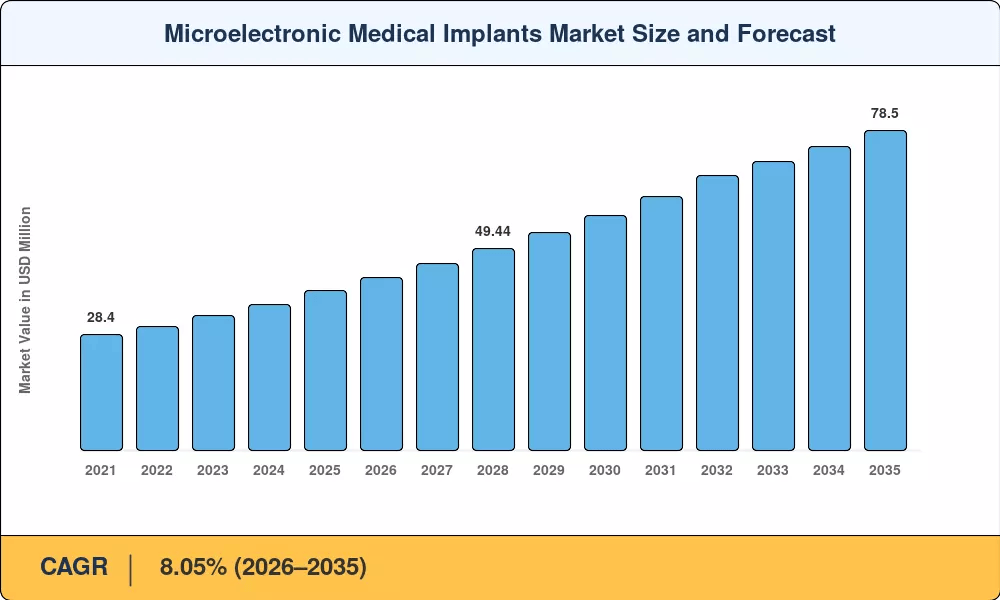
Microelectronic Medical Implants Market Size
Microelectronic Medical Implants Market to Surge from USD 42.35 Bn in 2026 to USD 78.50 Bn by 2035-By AI-Adaptive Biosensor Chips, Bioresorbable Electronics
NY, CA, UNITED STATES, June 15, 2026 /EINPresswire.com/ -- As per Market Research Future, the global Microelectronic Medical Implants Market size to reach USD 78.50 Billion by 2035 from USD 42.35 Billion in 2026, at a CAGR of 8.05% during the forecast period 2026--2035. The market base was estimated at USD 39.20 Billion in 2025.The 8.05% CAGR---anchored by structural demand across aging populations and chronic disease management rather than discretionary healthcare spending---is driven by three converging structural forces: the U.S. FDA's 2024 expanded De Novo pathway for AI-adaptive implantable biosensor chip platforms, the European Commission's EUR 1.8 Billion Horizon Europe allocation for next-generation miniaturized medical electronics through 2027, and the global demographic shift toward over 2.1 billion people aged 60+ by 2050, with cardiovascular disease remaining the world's leading cause of death.
National governments and multilateral health organizations are amplifying this momentum. The U.S. FDA granted seven breakthrough device designations for adaptive neurostimulation systems between 2023 and 2025, signaling regulatory willingness to fast-track AI-driven implant architectures. CMS's 2025 expansion of CPT code 93297 added an estimated 120,000 new billable patient-months annually for continuous remote monitoring of implantable biosensor chip devices.
The European Commission's Horizon Europe program allocated EUR 1.8 billion for next-generation miniaturized medical electronics through 2027. China's 14th Five-Year Plan earmarked CNY 45 billion for domestic implantable biosensor chip manufacturing capacity, with the NMPA streamlining Class III implant approvals in 2024 and cutting review timelines by 35%. India's Ayushman Bharat Digital Mission targets digital health infrastructure in 150,000 health and wellness centers by 2028, while Brazil's SUS expanded cardiac implant coverage in 2024 to include CRT-D devices, opening a USD 600 million addressable opportunity.
Together, these initiatives are creating the regulatory, reimbursement, and manufacturing infrastructure on which closed-loop therapeutic devices depend.
Request A Free Sample: https://www.marketresearchfuture.com/sample_request/2370
Key Market Trends & Growth Drivers
Aging Population and Rising Chronic Disease Prevalence
According to WHO projections, there will be more than 2.1 billion persons over 60 by 2050, and cardiovascular disease will continue to be the world's leading cause of death. Healthcare professionals perform between 150,000 and 200,000 primary pacemaker implantations in the United States alone each year, a sustained increase fueled by population aging and increased diagnostic capture rates.
India's National Programme for Prevention and Control of Non-Communicable Diseases aims to significantly lower premature cardiovascular mortality by increasing state-level public procurement budgets for neural electrode arrays and implantable biosensor systems throughout regional healthcare networks. This demographic reality creates a structural demand floor for cardiac rhythm management devices---the largest product sector in the Microelectronic Medical Implants Market.
AI-Enabled Closed-Loop Therapeutic Platforms
The FDA granted seven breakthrough device designations for adaptive neurostimulation systems between 2023 and 2025, signaling regulatory willingness to fast-track AI-driven implant architectures. Closed-loop platforms continuously sample physiological signals---such as local field potentials in Parkinson's patients---and adjust stimulation parameters in real time, reducing adverse effects by up to 40% compared with open-loop predecessors in pivotal trial data. Medtronic's Percept PC and Abbott's NeuroSphere Virtual Clinic represent first-generation embodiments of this approach, both relying on miniaturized medical electronics capable of edge inference at sub-milliwatt power budgets.
The MRFR model estimates that AI-adaptive devices will account for over 15% of total neurostimulation revenues by 2030, with clinical adoption accelerating as long-term efficacy data matures. Medtronic's January 2024 FDA approval for the Percept RC neurostimulator with exclusive BrainSense technology introduced the first rechargeable DBS system capable of capturing and recording real-time brain signals.
Miniaturized Medical Electronics and Wireless Implant Communication Standardization
A generational technology shift is underway as legacy pacemakers and fixed-rate neurostimulators built on discrete-component architectures give way to system-on-chip implants integrating neural electrode arrays, wireless implant communication modules, and onboard machine-learning inference engines.
The finalization of IEEE 802.15.6a in late 2025 establishes a unified physical-layer specification for in-body and on-body wireless implant communication, resolving years of proprietary-protocol fragmentation. Standardized communication enables interoperability between implanted sensors and external hubs---a prerequisite for the remote-monitoring reimbursement models that CMS and European payers are now mandating. Qualcomm's 2024 partnership with Boston Scientific to co-develop a 2.4 GHz implant-grade transceiver illustrates the convergence of consumer semiconductor capabilities with medical-grade reliability requirements.
Medtronic disclosed USD 2.1 billion in R&D spending on MEMS biomedical devices and algorithm-driven therapy platforms in its 2024 annual report, reflecting the industry's pivot from hardware-centric design to software-defined implant ecosystems.
Ask for Customization: https://www.marketresearchfuture.com/ask_for_customize/2370
Market Segment Insights
BY PRODUCT TYPE
Cardiac Rhythm Management Devices: Dominant segment with ~49.2% share in 2024. Pacemakers, ICDs, and CRT systems remain the revenue backbone, with an installed base exceeding 12 million active devices globally. The segment generates recurring remote-monitoring fees and replacement-cycle demand on 7--10-year battery-life cadences. Remote-monitoring mandates across U.S. and EU payer systems reinforce structural demand.
Neurostimulation Devices: Fastest-growing product category at 12.3% CAGR (2026--2035). Fueled by FDA breakthrough designations for closed-loop deep brain stimulation platforms. Applications span Parkinson's disease, epilepsy, treatment-resistant depression, and chronic pain. Neural electrode arrays fabricated on flexible conductive polymer substrates enable higher-density cortical recordings than rigid silicon alternatives.
Cochlear Implants: USD 4.80 Billion revenue in 2024. Bilateral implantation rates rising in pediatric populations. Cochlear Ltd's May 2024 acquisition of Oticon Medical's cochlear implant business for AUD 170 million consolidated the global market into three primary players.
Retinal Prostheses: 14.0% CAGR (2026--2035). Gene-therapy-combination approaches and cortical vision prostheses represent early-stage commercialization frontiers. Second Sight / Cortigent leads with cortical vision prosthesis technology.
Other Products (Implantable Drug Pumps, Bone Growth Stimulators): USD 2.70 Billion in 2024. Orthopedic and oncology applications drive demand for implantable drug delivery and bone fusion devices.
BY COMMUNICATION & POWER
Primary Battery-Powered Systems: Dominant segment with ~79.1% share in 2024. Lithium-based chemistries deliver proven, predictable device lifespans that clinicians and patients trust. Next-generation lithium-carbon-fluoride chemistries paired with hybrid capacitor architectures now enable projected device lifespans exceeding 15 years, reducing replacement surgery frequency.
Bioresorbable Electronics: Fastest-growing segment at 21.8% CAGR (2026--2035). Transient circuits built from silicon nanomembranes and zinc-molybdenum conductors dissolve within weeks, eliminating extraction procedures for temporary monitoring applications. Particularly valuable for post-craniotomy or post-cardiac-surgery monitoring. Northwestern University's advanced transient electronic designs have proven bioresorbable intracranial and intravascular pressure sensor architectures in animal models.
Wireless Rechargeable Systems: 9.5% CAGR (2026--2035). Neurostimulator recharging convenience drives adoption. Medtronic's Percept RC represents the first rechargeable DBS system with BrainSense technology.
Energy Harvesting: Emerging segment at USD 0.45 Billion (2025). Piezoelectric and thermoelectric prototypes scavenging mechanical movement or thermal energy from the body. NIH and ARPA-H programs actively support ultra-low-power biomedical sensor research to move implants toward self-sustaining systems.
BY END USER
Hospitals: Dominant segment with ~66.5% share in 2024. Surgical infrastructure and reimbursement channels drive demand. Academic medical centers perform the highest volumes of complex implantable pulse generator procedures.
Home Care Settings: Fastest-growing end user at 11.5% CAGR (2026--2035). Remote monitoring of implantable biosensor chip devices enables continuous patient management without hospital visits. Medtronic's CareLink network already manages over 4 million connected patients, generating recurring SaaS revenue alongside device sales.
Ambulatory Surgery Centers: 9.0% CAGR (2026--2035). Cost efficiency drives outpatient neurostimulator implants and leadless pacemaker procedures. Abbott's AVEIR DR dual-chamber leadless pacemaker system eliminates transvenous leads and reduces infection risk by 50% in initial registry data.
Specialty Clinics: USD 2.90 Billion (2025). Chronic pain management clinics and audiology centers drive demand for neurostimulation and cochlear implant programming services.
Read Detailed Insights: https://www.marketresearchfuture.com/reports/microelectronic-medical-implants-market-2370
Regional Outlook
North America --- Dominant Market (~42% Share, 2024)
The United States generates approximately 78.5% of North American Microelectronic Medical Implants Market revenue, driven by deep payer coverage, a high density of electrophysiology labs, and early FDA pathways for AI-adaptive neural electrode arrays. CMS's 2025 expansion of CPT code 93297 to cover continuous remote monitoring of implantable biosensor chip devices added an estimated 120,000 new billable patient-months annually.
Canada is growing at 8.2% CAGR on provincial cardiac-care pathway investments. Mexico's IMSS invested MXN 4.2 billion in 2024--2025 to upgrade cardiac catheterization capacity across 18 specialty hospitals, contributing USD 1.05 Billion (2025). North America's leadership rests on reimbursement depth, clinical-trial infrastructure, and regulatory innovation.
Europe --- Second Largest (~27% Share, 2024)
Europe's Microelectronic Medical Implants Market benefits from Germany's medtech manufacturing cluster and the EU MDR compliance wave reshaping competitive dynamics. Germany leads regionally with 24.3% of European revenue, anchored by Biotronik, Fraunhofer IMS, and a network of university hospitals driving both manufacturing output and clinical-trial throughput.
The UK is growing at 7.9% CAGR on the NHS Long-Term Plan, which earmarked GBP 1.4 billion for cardiac and neurological device programs through 2029. France's national genomic medicine integration with implants contributes USD 2.45 Billion (2025). Italy's aging population and cochlear implant program growth drive 6.5% CAGR. Spain's regional health authority procurement reforms contribute USD 1.10 Billion (2025).
The Nordic countries lead digital health and wireless implant communication adoption at 7.2% CAGR. The EU MDR's full enforcement timeline has compelled device makers to re-engineer legacy platforms, creating a near-term compliance burden but a medium-term quality and safety upgrade.
Asia-Pacific --- Fastest-Growing Region (10.4% CAGR, 2026--2035)
Asia-Pacific is the most dynamic growth theater for the Microelectronic Medical Implants Market. China commands 38.5% of regional revenue, with the NMPA streamlining Class III implant approvals in 2024 and cutting review timelines by 35% for domestically manufactured neural electrode arrays and implantable biosensor chip devices.
The 14th Five-Year Plan earmarked CNY 45 billion for domestic implant manufacturing capacity. India is growing at 12.5% CAGR, with cardiac implant volumes crossing 200,000 units in 2024 and MEMS biomedical devices increasingly sourced from domestic foundries in Hyderabad and Bengaluru.
Japan contributes USD 3.20 Billion (2025) through super-aging society demand for cochlear and retinal prostheses. South Korea leverages its semiconductor ecosystem at 9.8% CAGR, positioning as an emerging supplier of wireless implant communication ASICs. ASEAN medical tourism in Thailand and Singapore specialty centers drives 11.2% CAGR.
Middle East & Africa --- Emerging Opportunity (6.8% CAGR, 2026--2035)
Saudi Arabia leads the region with 30.5% of regional revenue, as Vision 2030 channels SAR 65 billion into healthcare infrastructure, including three new cardiac centers of excellence equipped to implant miniaturized medical electronics at volumes previously handled only by referral to European facilities.
The UAE leverages its medical-tourism corridor to attract patients from across the Gulf Cooperation Council, growing at 8.5% CAGR. South Africa's public-private partnership model is expanding implantable biosensor chip access in underserved provinces, contributing USD 0.35 Billion (2025). Egypt's universal health insurance rollout drives 7.0% CAGR. NGO-funded cochlear implant access programs support the rest of the region at USD 0.30 Billion (2025).
South America --- Growing Presence (USD 2.10 Billion, 2025)
Brazil anchors South America's Microelectronic Medical Implants Market at 62.0% of regional revenue, with 2024 SUS policy changes extending coverage to CRT-D and subcutaneous ICD devices for an additional 85,000 eligible patients annually. Argentina's private-sector cardiology center growth drives 7.5% CAGR. Early-stage adoption and donor-funded programs support the rest of the region at USD 0.40 Billion (2025).
Competitive Landscape and Recent Developments
The Microelectronic Medical Implants Market exhibits medium concentration, with the top five players commanding an estimated 55--60% combined revenue share. The Herfindahl-Hirschman Index sits near 1,200, indicating a moderately concentrated structure where scale in manufacturing, regulatory expertise, and clinical-trial networks creates meaningful but not insurmountable barriers to entry. Vertical integration---from MEMS biomedical devices fabrication through algorithm development to post-market data services---increasingly differentiates tier-one competitors from contract-manufacturing-dependent challengers.
The competitive landscape is stratified between large diversified medtech conglomerates controlling broad cardiac and neuro portfolios with integrated data-services platforms, mid-sized pure-play specialists in cochlear and neurostimulation segments, and emerging bioelectronic medicine companies developing bioresorbable and conductive polymer neural interfaces.
KEY COMPANIES AND RECENT MILESTONES
Medtronic (January 2024): Received FDA approval for the Percept RC neurostimulator with exclusive BrainSense technology, introducing the first rechargeable DBS system capable of capturing and recording real-time brain signals to guide personalized therapy adjustment in Parkinson's disease. Estimated revenue share: ~18--22% of global Microelectronic Medical Implants Market. Broadest cardiac + neuro portfolio; CareLink platform manages over 4 million connected patients.
Abbott Laboratories (November 2024): Launched the AVEIR DR dual-chamber leadless pacemaker system in Europe, eliminating transvenous leads and reducing infection risk by 50% in initial registry data. Estimated revenue share: ~12--15%. AI-adaptive neurostimulation with NeuroSphere Virtual Clinic; leadless pacemaker innovation.
Boston Scientific: Estimated revenue share ~10--13%. CRT-D and SCS platforms; Qualcomm partnership to co-develop a 2.4 GHz implant-grade transceiver. Emerging neurostimulation capabilities with wireless implant communication integration.
Cochlear Ltd (May 2024): Acquired Oticon Medical's cochlear implant business for AUD 170 million, consolidating the global cochlear market into three primary players. Estimated revenue share: ~6--8%. Global cochlear implant share leader with bilateral pediatric implantation focus.
Biotronik: Estimated revenue share ~4--6%. European manufacturing base with CRM devices and home monitoring. Remote-monitoring pioneer with strong regulatory expertise in EU MDR compliance.
Future Outlook: 2026—2035
By 2030, AI-adaptive and autonomous implant ecosystems will become the clinical standard. An estimated 30% of newly implanted neurostimulators will incorporate onboard machine-learning inference, enabling autonomous therapy adjustments without clinician intervention. This shift from periodic programming visits to continuous optimization mirrors the broader healthcare transition toward personalized medicine.
The Microelectronic Medical Implants Market will increasingly reward companies that combine neural electrode arrays with edge-AI silicon capable of sub-milliwatt inference---a capability that demands tight vertical integration between sensor, algorithm, and power-management subsystems. Computational digital twins simulating electrode-tissue interfaces will reduce physical prototyping iterations by 40--50%, shortening development timelines from 36 months to approximately 20 months for miniaturized medical electronics.
More Related Research Insights:
https://www.marketresearchfuture.com/reports/active-implantable-medical-devices-market-8834
https://www.marketresearchfuture.com/reports/neurostimulation-devices-market-2263
https://www.marketresearchfuture.com/reports/cardiac-monitoring-devices-market-68238
https://www.marketresearchfuture.com/reports/cochlear-implants-market-5256
https://www.marketresearchfuture.com/reports/retinal-implants-market-6580
https://www.marketresearchfuture.com/reports/brain-monitoring-market-2288
https://www.marketresearchfuture.com/reports/wearable-medical-device-market-899
https://www.marketresearchfuture.com/reports/medical-sensors-market-2038
https://www.marketresearchfuture.com/reports/bioelectric-medicine-market-11052
Larry Wilson
WantStats Research And Media Pvt. Ltd.
+1 855-661-4441
email us here
Visit us on social media:
LinkedIn
Facebook
YouTube
X
Legal Disclaimer:
EIN Presswire provides this news content "as is" without warranty of any kind. We do not accept any responsibility or liability for the accuracy, content, images, videos, licenses, completeness, legality, or reliability of the information contained in this article. If you have any complaints or copyright issues related to this article, kindly contact the author above.
